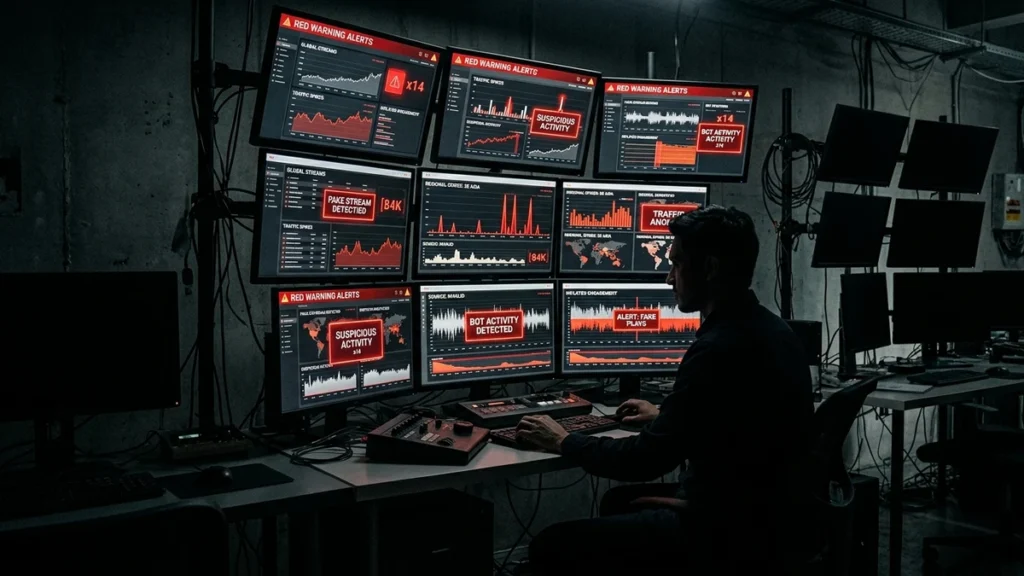
The streaming fraud crackdown 2026 just hit a historic milestone. Michael Smith, a 54-year-old from North Carolina, pleaded guilty on March 19, 2026. His crime? The first-ever AI-assisted streaming fraud case in the U.S. He used hundreds of thousands of AI songs and thousands of bot accounts. The result: over $8 million in stolen royalties. That money should have gone to real artists. Instead, it was drained from musicians whose fans were actually listening.
Smith’s case is just the tip of the iceberg. Apple Music flagged 2 billion fake streams in 2025. It then doubled fraud penalties in February 2026. Deezer now logs 75,000 AI tracks uploaded per day. The IFPI is pursuing legal action against fraud operators in Brazil. For years, platforms treated fake streams as a minor issue. Not anymore. The music industry now treats them as a crime — and the fallout is real.
Inside the $8 Million Streaming Fraud Scheme
The U.S. Department of Justice revealed how Smith ran his scheme. It was both methodical and brazen. Between 2017 and 2024, he:
- Created hundreds of thousands of AI songs to build a catalog big enough to dodge detection
- Set up thousands of bot accounts on Spotify, Amazon Music, Apple Music, and YouTube Music
- Used bots to stream his songs billions of times, copying real listening patterns
- Spread plays across thousands of tracks so no single song set off alarms
“Smith generated thousands of fake songs using AI, then streamed them billions of times,” said U.S. Attorney Jay Clayton. “The songs and listeners were fake. But the millions Smith stole were very real.”
Smith pleaded guilty to conspiracy to commit wire fraud. He faces up to five years in prison. He also agreed to give back $8,091,843.64 in stolen royalties. His sentencing is set for July 29, 2026.
Why This Matters: Streaming royalties come from a shared pool. Every fake stream pays the fraudster — and cuts the payout for every real artist. Smith’s billions of fake plays meant tiny deductions from millions of real musicians’ paychecks.
How Fake Streams Steal From Real Artists
Why does the streaming fraud crackdown 2026 matter? It starts with how streaming royalties work.
Spotify, Apple Music, and Amazon Music use a pro-rata model. All revenue goes into one pool. It gets split based on total streams. So if a fraudster grabs 1% of all plays, they steal 1% of every real artist’s pay. That hits everyone — from Taylor Swift to the indie artist with 500 monthly listeners.
Rolling Stone reported that Smith racked up billions of streams. At $0.003-$0.005 per stream, even a tiny share of total plays adds up to millions in stolen royalties.
The DOJ called it what it is: theft from real artists. Streaming fraud is not a victimless crime. The victims are every musician whose streams are worth a little less because fraudsters water down the royalty pool.
Apple Music’s 2 Billion Flagged Streams and Doubled Penalties
Apple Music flagged 2 billion fake streams in 2025. A February 2026 report from 9to5Mac confirmed that Apple then doubled its fraud penalties. Anyone caught gaming streams now faces twice the financial hit.
This shift reflects a bigger trend. Passive detection is not enough. Platforms are moving from finding fraud to punishing it. The goal: make cheating cost more than it pays.
But here’s the uncomfortable truth. If Apple caught two billion fake streams, how many did it miss? Experts say current systems only catch a fraction of the total. The most advanced fraud rings use AI to mimic real listening habits. They rotate through home IP addresses. That makes them very hard to spot.
Deezer Logs 75,000 AI Tracks Per Day
AI music generation is growing faster than platforms can keep up. Music Week reported on April 22, 2026 that Deezer now flags 75,000 AI-based tracks uploaded every single day. For a deeper look at the AI music flood, see our analysis of Deezer’s 44% AI-generated music problem.
Not all AI music is fraudulent. Some is made and shared honestly. But the sheer volume creates a needle-in-a-haystack problem. When 75,000 AI tracks hit a platform each day, telling a real experiment from a bot-farm scheme takes serious tech.
Deezer leads the way in anti-fraud tech. Its systems scan streaming patterns, account behavior, and track data. But modern fraud is getting smarter. ArtistRack’s investigation found that new fraud networks use “Ghost Listeners.” These are AI-made user profiles with fake but realistic listening histories. They are much harder to catch than simple bot accounts.
“With streaming royalties based on the pot of money generated by DSPs from subscriptions and advertising, any part of that diverted to fraudulent operators means less income for real artists and songwriters as well as rights-holders.” — Music Week
The Industry Fights Back: What Platforms Are Doing
Smith’s conviction isn’t happening in isolation. The music industry is mounting a coordinated response:
Criminal Prosecution
Smith’s case sends a clear message. Streaming fraud is now federal wire fraud — not just a rule violation. Future cheaters face prison, criminal records, and losing their money. Not just an account ban.
Platform-Level Detection
Spotify, Apple Music, Amazon Music, and Deezer all use AI-powered fraud detection now. These tools scan streaming data for red flags. Spotify has been flagging artificial streaming — an issue we’ve been tracking closely on PopHits News and penalizing distributors whose catalogs show suspicious patterns.
International Legal Action
The IFPI backs legal cases against fraud operators in Brazil and beyond. The goal: stop fraudsters from hiding behind borders.
Distributor Accountability
Platforms now hold distributors responsible too. If a distributor keeps sending AI catalogs with fake streaming patterns, it faces growing penalties. These range from frozen royalties to being kicked off the platform for good.
What This Means for Independent Artists
For indie artists, the streaming fraud crackdown 2026 brings good news and a warning.
The good news: Every fake stream removed means a bigger slice of the pie for real artists. Smith’s $8 million in stolen royalties is going back. And criminal charges scare off future cheaters.
The wake-up call: Fraud is a symptom of a deeper problem. The pro-rata model pools all revenue and splits it by total streams. That setup rewards cheating. As long as one fake stream cuts the value of one real stream, fraudsters will keep coming.
Artists should:
- Watch their streaming numbers for sudden drops in per-stream pay — a sign of rising fraud
- Use only legit promotion — any service selling “guaranteed streams” almost certainly uses bots
- Diversify revenue sources beyond streaming — explore artist strategies on PopHits like direct fan sales, sync deals, and live shows
- Report anything odd to their distributor and platform — unusual streaming patterns could mean fraud on their tracks
Is Streaming’s Business Model Broken?
Smith’s case highlights a core tension. The same pro-rata model that sent Spotify’s record $11 billion in 2025 payouts to artists also makes fraud pay off.
But other models exist. User-centric payments send your money only to artists you play. Under this system, a bot account’s fees only go to the tracks it streams. That kills the pool-dilution trick that makes large-scale fraud worth doing.
Deezer has pushed for user-centric pay. SoundCloud tried fan-powered royalties. But Spotify and Apple Music have been slow to act. Why? The shift would send more money to niche artists — and less to the biggest names. Major labels don’t want that.
The streaming fraud crackdown may accelerate this conversation. When fraud costs the industry billions and requires criminal prosecution to address, the case for structural reform becomes harder to ignore.
Key Dates in the Streaming Fraud Crackdown
- 2017-2024: Michael Smith operates his streaming fraud scheme across Spotify, Amazon Music, Apple Music, and YouTube Music
- September 2024: Smith is charged with wire fraud, wire conspiracy fraud, and money laundering conspiracy
- 2025: Apple Music flags 2 billion fraudulent streams; Spotify pays a record $11 billion in royalties
- February 2026: Apple Music doubles penalties for fraudulent streaming
- March 19, 2026: Smith pleads guilty — the first criminal conviction for AI-assisted streaming fraud
- April 22, 2026: Deezer reveals it now logs 75,000 AI-based tracks per day
- July 29, 2026: Smith’s sentencing scheduled (up to 5 years)
Discover More Music Industry Insights
Stay ahead of the biggest stories shaping the music business — from streaming economics to artist rights and technology trends.
Read More on PopHits.Co






About The Author