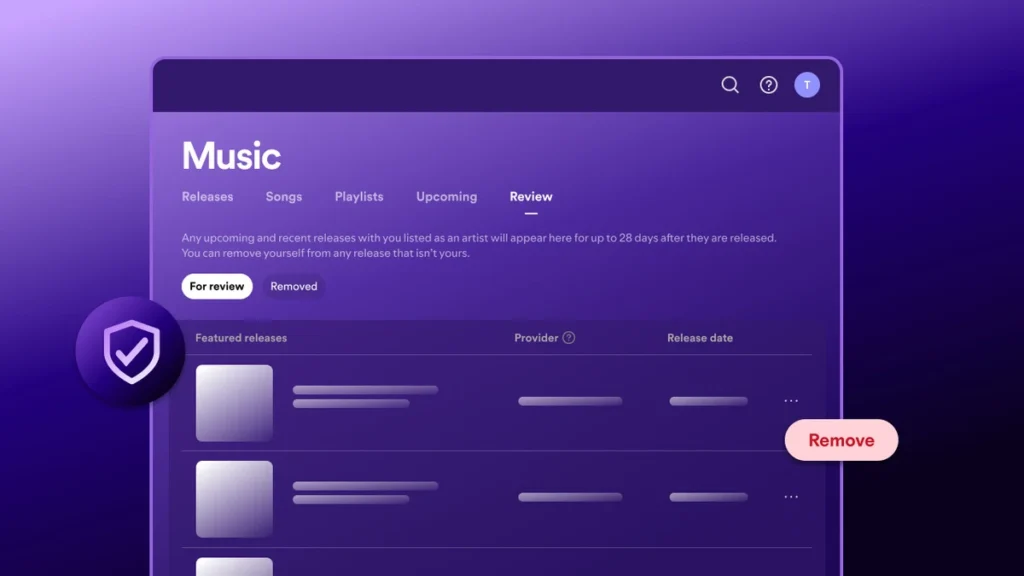
Twenty-eight days. That is how long an artist on Spotify now has to look at a release carrying their name and decide that it is not theirs. Since Tuesday 17 November, Artist Profile Protection has been open to every artist on the platform, letting them review new releases delivered to Spotify under their name and remove themselves from the ones they did not make, Music Business Worldwide reported.
It sounds like a small administrative fix. It is really an answer to one of streaming’s oldest structural problems, made sharper by a new one. Spotify says music can land on the wrong artist’s page because of metadata errors, artists who share the same name, or deliberate impersonation. In a blog post announcing the beta, the company said “the rise of easy-to-produce AI tracks” had made the problem worse, according to MBW.
How Artist Profile Protection Works
The feature is optional. Artists switch it on in Spotify for Artists, either from the artist settings menu on desktop or the music tab in the mobile app, and team admins and editors can manage it, Spotify explained on its Spotify for Artists blog. Once it is on, the artist receives an email whenever music is delivered to Spotify with their name attached.
From there the artist can review eligible releases and remove themselves from any that are not theirs. A declined release will not appear on their profile, count toward their Spotify stats or be recommended to their listeners, MBW reported. Spotify’s own explanation adds a useful caveat: the release may still appear under the artist’s name on other streaming services, so artists may still want to tell their label or distributor.
There are two modes. Under the default, which Spotify calls Review releases, new music still goes live as scheduled unless the artist steps in, and artists have up to 28 days after a release goes live to act on it, according to the company’s help centre as cited by MBW. An advanced setting, Block releases, requires the artist’s approval before any release can list them. Artists using it can give trusted distributors a unique “artist key,” which marks releases delivered with it as pre-approved.
Spotify recommends the stricter mode for artists in situations prone to misattributed releases, such as those with a common artist name or those who frequently see mismatches, the blog said. For everyone else, the default is designed to stay out of the way.
The Turn From Blocking to Reviewing
That default is the most interesting detail in the rollout, because it is not the one Spotify started with. When the tool went into beta in March, releases that an artist did not act on were blocked from their profile by default, MBW reported at the time. The version now available to everyone flips that: inaction means the release goes live.
Spotify says it worked with thousands of artists during the beta to refine the tool and to make it easier for them to protect their profiles “without disrupting release schedules,” according to MBW. That phrase explains the change. A system that blocks by default protects an artist from impersonators, but it can also hold back legitimate releases, such as a collaboration delivered by another act’s distributor, until someone remembers to approve them.
The trade-off is real either way. Review mode keeps the catalogue moving and puts the burden of vigilance on the artist, who has to notice the email and act within four weeks. Block mode puts the gate first and the paperwork second. By making the gentler option the default and the stricter one a choice, Spotify has in effect put uninterrupted release schedules first for most artists, while giving the artists most at risk a way to lock the door.
What Spotify and the Beta Testers Say
Spotify is presenting the tool as a first. “Artists should never have to find someone else’s music under their name,” said Sam Duboff, Global Head of Marketing and Policy at Spotify for Artists, as quoted by MBW. “Their artist profile should be in their control.”
“Starting today, every artist on Spotify can use Artist Profile Protection to review what shows up on their profile and prevent spammy and incorrect releases from ever reaching their page or their fans. We’re the first and only streaming service with a solution to the industry wide problem of content mismatch, and we hope it sets a new standard for streaming platforms,” Duboff added. Duboff gave a near-identical statement to TechCrunch.
Artists who used the feature during the beta include Diplo, Samia, Searows and Dave East, as well as the duo The Army, The Navy, according to Spotify. Robbie Mackey, a partner at Samia’s label Grand Jury Music, said: “The connection Samia’s fans have to her music is special. We’re glad Spotify is giving us more control over what appears under her name.” Kyle McEvoy, co-founder and CEO of Cloverdale Records and manager of Evan Honer and Winyah, said: “Protecting artists’ identity is more important than ever. Spotify is setting a new standard by being the first platform to give artists this level of control.” Both were quoted by MBW.
The Scale of the Problem
The numbers behind the rollout show why labels are paying attention. By the end of September 2026, Sony Music had sought the removal of more than 260,000 AI-generated tracks impersonating its artists from digital platforms, according to the Financial Times as reported by MBW. That was almost double the 135,000 tracks Sony had sought to remove by the end of March.
“We will keep enforcing our artists’ rights and expect platforms to act quickly and to prevent the same content from reappearing,” Sony told the FT, as quoted by MBW. “But it’s becoming an uphill struggle.” TechCrunch noted that Billboard had reported the same 260,000 figure last month.
Spotify’s own figures point in the same direction. In an update on 20 October, when it promised to make the tool available to all artists by the end of the year, the company said it had taken more than 50 million “slop and spam” tracks out of its recommendations so far in 2026, MBW reported. Artist Profile Protection deals with a narrower slice of that flood: the tracks that do not just clutter the service, but borrow a real artist’s name to do it.
Part of a Wider Identity Push
The tool is the latest in a series. Spotify introduced the Verified by Spotify badge in April, and more than 300,000 artists had been verified under that programme as of 20 October, according to the company, MBW reported. In September 2025 it introduced an impersonation policy and said it was “ramping up” investment to stop uploaders from fraudulently placing music on other artists’ profiles.
The company’s own framing is candid about the cause. Open-access distribution channels have lowered the barrier for independent artists to share music with the world, Spotify wrote on its artist blog. “But that openness comes with gaps that bad actors can exploit.” The same openness that lets a bedroom producer reach dozens of services at once lets an impersonator do the same.
Not every AI story at Spotify is defensive: pophits.co has covered how Spotify AI remixes could cost up to $5 a month and pay artists who opt in. Profile protection is the other half of that arc: if a platform is going to invite AI into the catalogue on its own terms, it also has to give artists a way to keep everyone else’s AI off their page.
What Artists Should Do Now
For most independent artists, the practical steps are short. Turn on Artist Profile Protection in Spotify for Artists, make sure the team members who handle releases are admins or editors, and watch for the notification emails, since the default mode gives 28 days to act after a release goes live.
Artists with a common name, or a history of finding strangers’ music on their page, should consider Block releases and give their distributor an artist key so that their own releases are pre-approved. And because a removal applies only on Spotify, it is worth telling the distributor or label whenever a misattributed release turns up, so the same fix can be made elsewhere.
About The Author