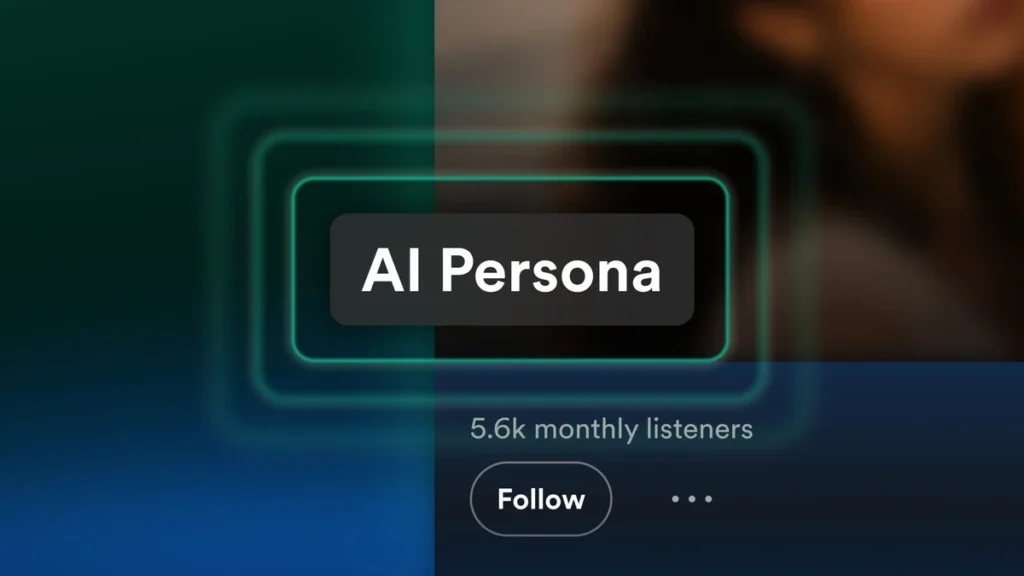
The AI Persona badge on a Spotify artist profile
The AI Persona badge on a Spotify artist profile
Spotify’s AI Persona badge, announced on 11 August for a mid-September start, is now rolling out in the Spotify app. The label marks artist profiles whose public identity appears to be an AI-generated photorealistic person, and it carries a consequence that matters more to artists than the badge itself: by default, music from those profiles is left out of Spotify’s editorial and algorithmic recommendations.
For independent artists, the rules are narrower than many headlines suggest. The AI Persona badge is about who an artist presents as, not how the music was made. An artist who uses AI tools in production but presents as a real person, a stage name or a fictional character is outside its scope, according to Spotify’s help pages for artists.
What the Badge Actually Marks
In its announcement, Spotify said listeners had been “clear in telling us that they don’t like seeing an artist profile that seems human, only to find out that the persona is AI-generated.” The company defines an AI Persona as an artist whose public identity represents an AI-generated photorealistic human. Its help page for artists says that can include AI-generated profile images, header images, album artwork or other visual elements that represent the artist.
There are two versions of the label. “AI persona” appears when an artist has chosen to identify as one through Spotify for Artists. “Likely AI Persona” appears when Spotify’s own review has concluded that a profile represents an AI-generated identity. Listeners can tap the badge to see which applies. It shows next to the artist name on the profile, in the Artist Badges section of the About page and next to the artist name in Search on mobile, and Spotify’s announcement said it would also appear on track rows across playlists.
“This badge is about the artist’s public identity, not about how the music was made,” Spotify said.
Why the Recommendation Rule Matters More Than the Label
The practical cost of the badge is reach. “By default, Spotify will not include AI Personas in any editorial or algorithmic recommendations,” the company said. The artist help page puts it the same way: music from AI Personas is not included in editorial or personalised recommendations unless a listener intentionally engages with the artist, for example by following them.
Because the exclusion covers both editorial playlists and personalised recommendations, a badged profile loses the discovery routes Spotify controls and keeps only the listeners who come looking for it. Spotify framed the policy as a programming choice rather than a verdict on the music itself: “While we believe all artists have creative choice in determining how they present themselves, Spotify’s programming is focused on elevating music from authentic artists building careers in music.”
Who Gets Reviewed First
Spotify is not relying on artists to label themselves. Self-disclosure opened in Spotify for Artists on 11 August, but the company said it “won’t rely on self-disclosure alone” and would review profiles whose name and imagery appear to represent photorealistic AI-generated identities.
Its help page says the review started with artists who have met defined audience thresholds, which allows thorough, accurate reviews while keeping the pool of profiles manageable. In the announcement, Spotify said that approach means the labels cover the vast majority of artist profiles that users visit. It also said listeners will be able to report profiles they believe represent AI Personas to its review team in the coming months.
The help page adds a caution for anyone checking their own profile: the badges are gradually rolling out in the Spotify app, so not every listener will see them yet.
What Artists Can and Cannot Undo
The decisions are hard to reverse, which is the detail independent artists and their managers should read twice. According to Spotify’s help page:
- Self-disclosure is one-way. An artist cannot turn the AI Persona setting off after switching it on, and Spotify advises turning it on only if you are sure your profile represents an AI Persona. A mistaken disclosure has to be raised with Spotify directly.
- A Spotify-applied badge stays unless you act. Artists receive a notification in Spotify for Artists and can either confirm the badge by self-disclosing or appeal it. If they do nothing, the Likely AI Persona badge remains on the profile.
- Spotify has the final word. Artists cannot remove a Spotify-applied badge themselves, and the company says it makes all final decisions after reviewing the available information.
- A new identity can mean a new review. Changing the artist name, profile image, bio or other identity information may prompt Spotify to review the profile again.
AI Tools Are Not the Same as an AI Persona
For producers and artists who use generative tools in their workflow, this distinction is the one that counts. Spotify’s help page says the badge does not apply to an artist who uses AI tools to make music while the profile represents a real person, or to one who uses a stage name or fictional character that does not depict an AI-generated photorealistic person.
How the music was made is covered by a separate system. AI Credits let artists tell listeners how they used AI in their music, and Spotify says tens of thousands are submitted daily. Artists add those credits through their distributor, and the help page notes that the feature is still rolling out to more content providers, so it is worth asking a label or distributor whether it is available yet.
Alongside both sits Verified by Spotify, which signals that an artist is a real human presenting themselves authentically. Spotify says hundreds of thousands of profiles are already verified, the majority of them independent artists, representing more than 99% of the artists its listeners actively search for.
How Spotify’s Approach Compares With Deezer’s
Spotify is not the first service to limit the reach of AI output, but it draws the line in a different place. Deezer tags AI-generated music itself. In July, Deezer reported that fully AI-generated tracks had passed half of its daily uploads for the first time, peaking in June with a monthly average of 90,000 tracks a day, and that detected AI tracks are excluded from its algorithmic recommendations and editorial playlists. It said those tracks account for only 1% to 3% of streams, and that up to 85% of the streams they generated in 2025 were fraudulent.
Spotify’s badge leaves the audio out of it and asks a narrower question: is there a real person behind this profile? The pressure behind both approaches is similar. NPR noted that controversy broke out last summer after The Velvet Sundown, a generative AI project presented as a human band, gathered millions of streams in a matter of weeks, and that a Luminate study found listeners’ interest in AI music decreasing, particularly among Gen Z and Gen Alpha.
Questions about who is presenting as whom are not limited to artist profiles. Earlier this month, PopHits reported that Suno pulled a Mary J. Blige ad it says she never approved.
What Independent Artists Should Check Now
For most artists the badge will never apply. For anyone using generated imagery, a short audit is worth the time:
- Look at the profile the way a reviewer would. Check the name, profile photo, header image and artwork. If any of it is an AI-generated image of a realistic person who does not exist, the AI Persona badge may apply.
- Do not self-disclose casually. Once switched on, the setting cannot be switched off by the artist.
- Watch Spotify for Artists notifications. A Likely AI Persona badge stays unless it is confirmed or appealed.
- Use AI Credits for process transparency. Disclosing AI use in production goes through a distributor and is separate from the persona badge.
- Know the other label. Verified by Spotify is the platform’s signal that a real human is behind a profile.
The badge does not remove AI Personas from Spotify. Listeners can still find, follow and play them. What changes is that Spotify will no longer put them in front of listeners who did not go looking for them.
About The Author