
Physical sales and merchandise carry margins streaming cannot approach
Physical sales and merchandise carry margins streaming cannot approach
There is a number that explains almost everything about how musicians actually earn, and it is not a per-stream rate. It is this: artists who spread their earnings across four to six separate income streams consistently report two to four times the total income of artists relying on streaming alone.
Not two to four times the streaming income. Two to four times the total. The same catalogue, the same audience, a different set of routes to market.
Why Streaming Alone Cannot Work for Most
The reason is structural rather than moral, and it is worth stating precisely. Collabhouse’s breakdown of music income puts it bluntly: the top 1% of artists on Spotify capture 90% of all streams, which leaves most artists earning under $10,000 a year from the platform.
Run the arithmetic on an ordinary release. A million Spotify streams produces roughly $3,000 to $5,000 in master royalties, at a per-stream rate between $0.003 and $0.005. A million streams is a genuinely good year for an independent artist. It is not a living.
The rates differ more than most artists realise. Tidal pays between $0.012 and $0.015 per stream, Apple Music between $0.007 and $0.010, Amazon between $0.004 and $0.008, and YouTube Music between $0.001 and $0.003. The gap between the top and bottom of that list is more than tenfold for the identical play.
None of that changes the underlying shape. Streaming distributes a fixed pool according to share, and share is concentrated. An artist cannot out-work a distribution curve.
The Money Most Artists Leave Uncollected
Before diversifying anywhere, there is money already owed that frequently goes unclaimed, and this is the cheapest gain available.
Publishing royalties add 30% to 50% on top of streaming income. At a million streams that is a further $900 to $1,200; at ten million it is $9,000 to $12,000. Mechanical royalties run at roughly 15.3% of platform revenue, and performance royalties split evenly between songwriter and publisher.
This is not new revenue. It is revenue generated by plays that have already happened, sitting with collection societies, waiting on a registration. The same pattern appears in neighbouring rights, where digital performance royalties pay artists 45% directly, if they register. The conditional clause is doing the work in both cases.
The Fans Who Are Not Average
The most consequential finding in the current data concerns who is actually paying, and it dismantles the idea that audience size is the thing to optimise.
Research from MIDiA cited in the same breakdown puts superfans at 1.9% of listeners and 42% of total revenue. Spotify’s own figures show the top 2% of listeners generating 18% of streams and more than half of all merchandise sales. Goldman Sachs values the global superfan market at $4.5 billion, with the average superfan spending around $1,000 a year on a single artist.
Roughly two percent of an audience produces something close to half of the money. That is the central fact, and it reframes the goal entirely. An artist chasing monthly listeners is optimising for the 98% who will never spend anything beyond a subscription they pay to somebody else.
Subscriptions turn this into arithmetic anyone can run. Two hundred subscribers at $10 a month is $2,000 in recurring monthly income, which exceeds what a million annual Spotify streams pays. Two hundred people is a small room, not a stadium.
What the Other Streams Actually Pay
The diversification argument only holds if the alternatives pay properly, and the ranges are wider than the streaming figures suggest.
Live is the most immediate. A show for 300 people at $15 a ticket, with $8 a head in merchandise, grosses about $6,900 a night. Three of those a week is a full-time income, and it comes with no algorithm attached.
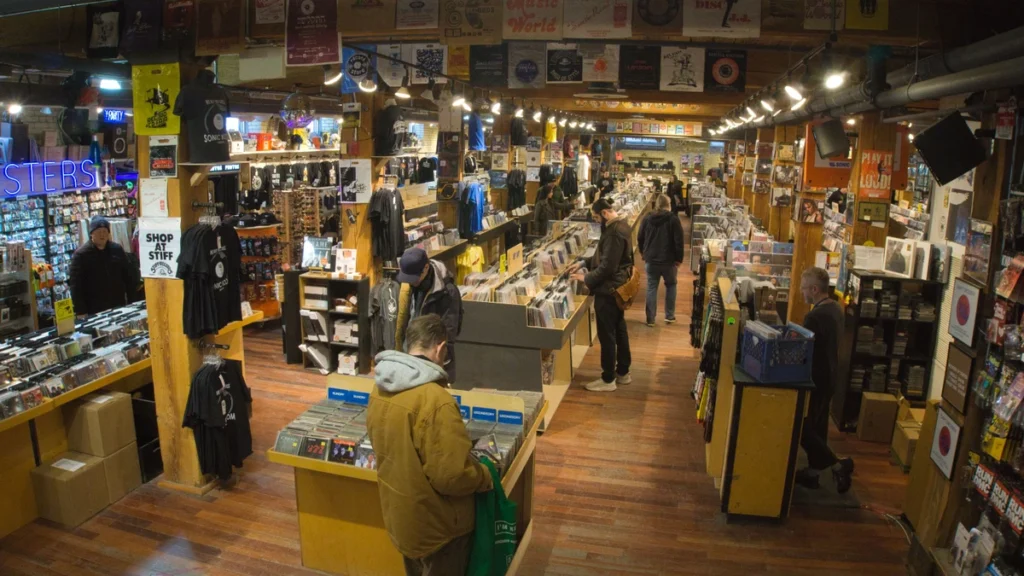
Merchandise carries margins streaming cannot approach. Vinyl costs $8 to $15 a unit to produce and sells for $25 to $35. CDs cost $1 to $2 and sell for $10 to $15. US vinyl sales reached 47.9 million units in 2025, up 8.6%, and direct-to-consumer now accounts for 13.6% of all physical album sales.
Sync licensing has the widest range of all. A podcast placement pays $100 to $1,000. A cable or streaming television episode pays $2,000 to $15,000, a major network episode $5,000 to $30,000, and a national television commercial anywhere from $15,000 to over $150,000. Feature use in a major film can exceed $200,000.
Then there are the streams that use the skill rather than the catalogue: session work at $500 to $1,500 a day, beat licensing from $20 for a non-exclusive lease to $5,000 and up for exclusive rights, teaching at $30 to $300 an hour, and grants running from $1,000 to $50,000.
Why Four Streams and Not Twelve
The finding specifies four to six, and the ceiling matters as much as the floor.
Every one of those income streams carries an overhead. Merchandise means inventory, storage and fulfilment. Live means booking, travel and equipment. Teaching means scheduled hours that cannot be moved. Sync means pitching and a catalogue registered correctly enough to be licensable at short notice. Each one is a small business attached to the music.
Four to six is roughly what one person can run without the administration consuming the time that was supposed to go into recording. Beyond that, the marginal stream starts costing more attention than it returns, and the artist becomes an operations manager who occasionally writes songs.
The selection matters more than the count. Four income streams serving the same two percent of superfans compound, because a person who buys the vinyl is the person who buys the ticket and joins the subscription. Four unrelated streams are four separate jobs.
The Model That Makes the Maths Work
The clearest framing of the whole argument is the oldest one. A thousand engaged fans spending $100 a year each produces $100,000 of annual revenue, which is a sustainable career.
Against the superfan data, $100 a year is conservative: the average superfan spends nearer $1,000. And a thousand people is an achievable audience. It is a sold-out mid-size room, or a mailing list, or a subscriber base built over several years.
Reaching $100,000 through streaming alone would require somewhere between twenty and thirty million Spotify streams, which places an artist near the top of the distribution curve described earlier. The two routes to the same income are not remotely comparable in difficulty.
The Industry Is Growing, and the Question Is Where You Stand In It
None of this describes a failing business. Global recorded music revenues reached $31.7 billion in 2025, and Spotify alone paid out $11 billion to rights holders, which the company describes as the largest annual payment to music from any retailer in history. It also reports that independent artists and labels accounted for half of all royalties paid.
Money is entering the industry in volume. The difficulty is that streaming distributes it by share, and share follows scale. An artist with a small, committed audience is structurally disadvantaged in that system and structurally advantaged in almost every other one, because vinyl, tickets, subscriptions and sync all reward depth of attachment rather than breadth of reach.
The practical conclusion is not that streaming should be abandoned. It remains the discovery layer, the thing that introduces the two percent who will eventually pay properly. The mistake is treating it as the destination when it is the front door.
For an artist deciding where to put the next month of effort, the arithmetic is unusually clear. Registering publishing recovers money already earned. Two hundred subscribers beat a million streams. Three shows a week to three hundred people is a salary. None of those require the algorithm to choose you.
About The Author