
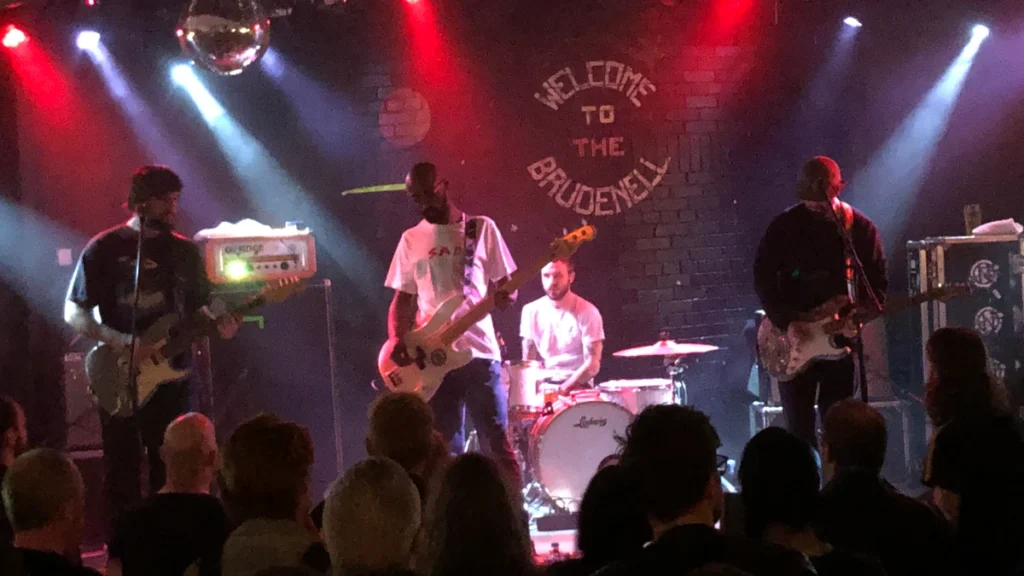
There is a pub on Bristol’s waterfront with a capacity of 140. The Louisiana has been putting on live music since the late 1980s, and its walls carry photographs of people who went on to fill buildings a hundred times its size. As Clash documented in a feature on the sector, Amy Winehouse played there in 2003, the year her debut arrived. The White Stripes played there. So did Dua Lipa, Florence and the Machine and Scissor Sisters. Coldplay played it four times.
None of them started at Wembley. That is the entire argument for the grassroots ticket levy, and after a long stretch in which the argument was all anyone had, the money has finally started moving.
What the First £200,000 Actually Bought
Music Venue Trust has begun deploying a £200,000 allocation from the LIVE Trust, funded by the voluntary £1 contribution taken from tickets at venues over 5,000 capacity. NME reported the breakdown in April, and it is unusually specific for a sector-support package.
The programme called Raise The Standard puts money into sound, lighting and backline systems, which is the least glamorous and most useful thing on the list. Stay The Night provides accommodation to make touring viable. Feel At Home addresses backstage areas and artist facilities. Off The Grid runs energy audits with the aim of reducing and eventually eliminating long-term energy costs, and an Emergency Response Hardship Fund reaches venues in immediate financial distress.
Read that list as an artist rather than as a policy observer and the shape becomes clear. Two of the five items are about whether a band can physically get through a tour: somewhere to sleep, and a room to sit in before the show. Two more are about whether the building will still be open next year. Only one is about the sound.
The Arithmetic That Made It Necessary
Thirty grassroots venues closed permanently between July 2024 and July 2025. In that same year more than half of the venues still standing made no profit at all, and over 6,000 jobs went.
Set that against the top of the market and the gap is the story. UK live music contributed a record £8 billion to the economy, while the grassroots sector subsidised live music to the tune of £76.6 million in 2025. The bottom of the ladder is not merely struggling; it is paying for the privilege of holding the rest of the structure up.
That is what a levy corrects. A pound from an arena ticket is invisible to the person buying it and material to a 140-capacity room, because the two operate at completely different scales of margin. The mechanism is not complicated and it is not new. Versions of it already run in several European countries, and the closest domestic analogy is the way money moves down the English football pyramid.
Only 8.8% of Big Shows Paid In
The scheme is voluntary, and that is where it has struggled. The expectation was that half of stadium and arena gigs would be contributing by the end of 2025. The figure achieved was 8.8%.
Music Venue Trust chief executive Mark Davyd named the problem directly, praising SJM, Kilimanjaro and AEG for delivering and putting the shortfall at the door of the market leader. “These companies are delivering,” he said of the promoters who had signed up. “Live Nation, you know, and the whole industry knows, you are not.”
He went further, per NME’s account of the annual report: if the voluntary levy fails, he argued, it will not be the fault of the companies that embraced it, of Music Venue Trust, of the government, or of any artist or audience, but a direct consequence of the dominant force in the arena and stadium market choosing not to deliver.
Artists have been less equivocal than the companies. Ben Lovett of Mumford & Sons told NME it was “too easy” to build the £1 into their arena tour, asking “why not do that?” and adding that withholding it “feels like a weird thing” at this stage. Contributions have come from Sam Fender, Pulp, Radiohead, Kneecap, Ed Sheeran, Take That, The Cure, Biffy Clyro, Enter Shikari, Lily Allen and Foo Fighters, among others.
Where the Rest of the Money Goes
The £200,000 for venue infrastructure is one slice. The LIVE Trust had distributed £500,000 in total at that point, with £5 million earmarked to be given out across the year to artists, venues and promoters.
A separate £125,000 went into the UKAT fund, launched by the Featured Artist Coalition with the Music Managers Forum and the Musicians’ Union, aimed squarely at the cost of touring rather than at the buildings. NME reported that allocation in March.
Splitting the money between venues and artists is the right instinct, because the two failures are different. A venue closes because its costs exceed its takings. A tour is abandoned because the artist cannot personally absorb the loss of driving to a town, playing to 90 people and paying for a hotel. Fixing one without the other produces open rooms with nobody willing to play them.
Why Accommodation Is the Smartest Line Item
Stay The Night looks like the least serious item on the list and is probably the most consequential, because accommodation is the cost that decides whether a tour happens at all.
A band playing a 200-capacity room takes a fee that was set when hotel rooms were cheaper. The fee has not moved much; the room has. What follows is the quiet arithmetic that removes an act from the road: the show breaks even, the night after it does not, and the fourth date of a run turns a modest profit into a loss. Nobody announces that they have stopped touring for want of a bed, but the effect is the same.
Providing accommodation directly, rather than raising fees, is also the cheaper intervention. It buys the same outcome at a fraction of the cost, and it lands on the artists least able to absorb the expense rather than being spread evenly across everyone on the bill. For any self-releasing act reading this as a practical matter, these are the schemes worth knowing exist.
What Happens If the Voluntary Model Fails
The government has held the same position throughout: let the industry make the voluntary levy work, and legislate only if it does not. Creative Industries Minister Ian Murray urged major venues, artists and promoters to adopt the levy on stadium and arena concerts, with £1 from every ticket sold going to the grassroots, and said of the market leader that it “could make a major positive impact if it changes its stance”.
A deadline of 30 June 2026 was set after the first target was missed. If the threshold of half of arena and stadium shows contributing is not reached, statutory legislation becomes the stated next step rather than a threat held in reserve.
Music Venue Trust’s own framing of why this matters was blunt: grassroots venues cannot keep being expected to survive on goodwill and admiration alone. The sector has spent a decade being praised in speeches and closed in practice, and the levy is the first mechanism that converts the praise into a number.
For independent artists the practical takeaway is narrower and more useful than the policy debate. There is now money specifically allocated to the cost of getting you to a stage and back, administered by the Featured Artist Coalition and Music Venue Trust rather than by a label. It is worth finding out what you qualify for, in the same way it is worth understanding how digital performance royalties pay artists 45% directly if they register. Both are money already set aside, and both are routinely left unclaimed.
About The Author