
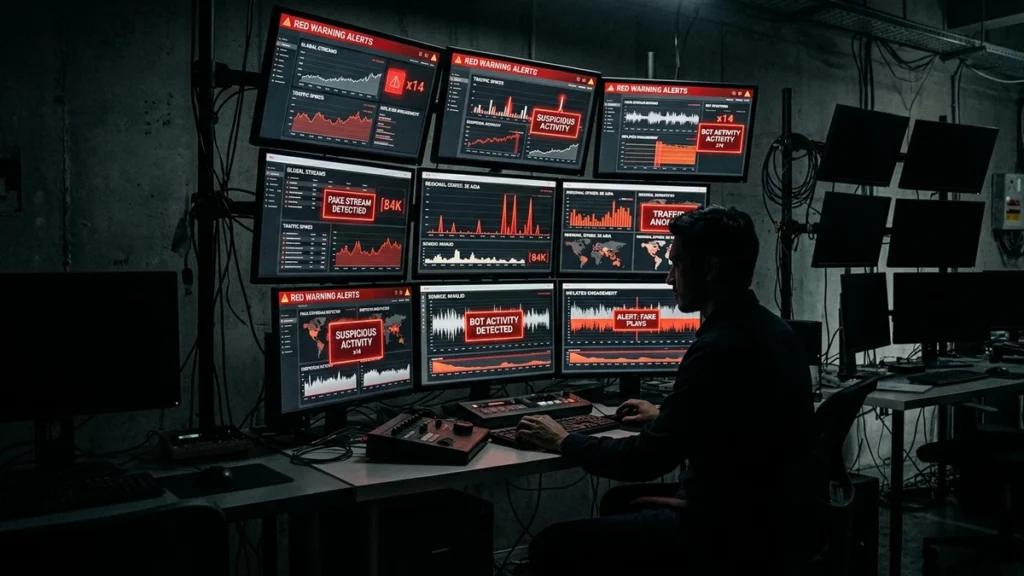
The streaming fraud crackdown of 2026 just reached a historic milestone: Michael Smith, a 54-year-old North Carolina man, pleaded guilty on March 19, 2026 to the first-ever criminal prosecution for AI-assisted streaming fraud in the United States. Using hundreds of thousands of AI-generated songs and thousands of bot accounts, Smith stole over $8 million in royalties from real artists — money diverted from legitimate musicians whose songs were actually being listened to by real people.
Smith’s case is just the tip of the iceberg. Apple Music flagged 2 billion fraudulent streams in 2025 and doubled its fraud penalties in February 2026. Deezer now logs 75,000 AI-based tracks uploaded per day. The International Federation of the Phonographic Industry (IFPI) is pursuing legal action against streaming fraud operators in Brazil. After years of treating fake streams as a nuisance, the music industry is finally treating them as a crime — and the consequences are real.
Inside the $8 Million Streaming Fraud Scheme
According to the U.S. Department of Justice, Michael Smith’s operation was methodical and sophisticated. Between 2017 and 2024, he:
- Created hundreds of thousands of AI-generated songs to amass a catalog large enough to avoid detection
- Registered thousands of bot accounts on Spotify, Amazon Music, Apple Music, and YouTube Music
- Used automated software to stream his songs billions of times, mimicking real consumer listening patterns
- Spread streams across thousands of tracks so no single song triggered anomaly detection
“Michael Smith generated thousands of fake songs using artificial intelligence and then streamed those fake songs billions of times,” said U.S. Attorney Jay Clayton. “Although the songs and listeners were fake, the millions of dollars Smith stole was real. Millions of dollars in royalties that Smith diverted from real, deserving artists and rights holders.”
Smith pleaded guilty to one count of conspiracy to commit wire fraud, which carries a maximum sentence of five years in prison. He also agreed to forfeit $8,091,843.64 in ill-gotten royalties. Sentencing is scheduled for July 29, 2026.
Why This Matters: Streaming royalties come from a shared pool. Every fraudulent stream doesn’t just pay the fraudster — it actively reduces the payout for every legitimate artist on the platform. Smith’s billions of fake streams meant billions of micro-deductions from real musicians’ paychecks.
How Fake Streams Steal From Real Artists
To understand why the streaming fraud crackdown of 2026 matters, you need to understand how streaming royalties work.
Platforms like Spotify, Apple Music, and Amazon Music operate on a pro-rata model: all subscription and advertising revenue goes into a single pool, then gets divided proportionally based on total streams. If a fraudster generates 1% of all streams on a platform, they siphon off 1% of every real artist’s earnings — from Taylor Swift down to the indie musician with 500 monthly listeners.
The Rolling Stone reported that Smith’s scheme generated billions of streams across major platforms. At an average payout of $0.003-$0.005 per stream, even a fraction of a percent of total platform streams translates to millions in diverted royalties.
“Millions of dollars in royalties that Smith diverted from real, deserving artists and rights holders,” the DOJ emphasized — a direct acknowledgment that streaming fraud isn’t a victimless crime. The victims are every musician whose legitimate streams are worth slightly less because fraudsters dilute the royalty pool.
Apple Music’s 2 Billion Flagged Streams and Doubled Penalties
Apple Music flagged 2 billion fraudulent streams in 2025, according to a February 2026 report from 9to5Mac. In response, Apple doubled its fraud penalties — meaning artists or distributors caught manipulating streams now face twice the financial consequences they did before.
Apple’s crackdown reflects a broader industry realization: passive detection isn’t enough. The platforms are shifting from identifying fraud to punishing it, creating financial deterrents that raise the cost of manipulation beyond its potential profit.
But two billion flagged streams raises an uncomfortable question: how many fraudulent streams weren’t caught? Industry analysts estimate that detection systems catch only a fraction of total manipulation, particularly from sophisticated operations that use AI to generate realistic listening patterns and rotate through residential IP addresses.
Deezer Logs 75,000 AI Tracks Per Day
The AI generation problem is accelerating faster than platforms can respond. Music Week reported on April 22, 2026 that Deezer now flags 75,000 AI-based tracks uploaded every single day.
Not all AI-generated music is fraudulent — some is legitimately created and distributed. But the sheer volume creates a needle-in-a-haystack problem for fraud detection systems. When 75,000 AI tracks hit a platform daily, distinguishing between a legitimate AI music experiment and a bot-farm operation requires increasingly sophisticated analysis.
Deezer has been at the forefront of anti-fraud technology, implementing its own detection algorithms that analyze streaming patterns, account behavior, and track metadata. But as ArtistRack’s investigation into Streaming Fraud 2.0 revealed, modern fraud networks use “Ghost Listeners” — AI-generated user profiles with realistic listening histories that are far harder to detect than simple bot accounts.
“With streaming royalties based on the pot of money generated by DSPs from subscriptions and advertising, any part of that diverted to fraudulent operators means less income for real artists and songwriters as well as rights-holders.” — Music Week
The Industry Fights Back: What Platforms Are Doing
Smith’s conviction isn’t happening in isolation. The music industry is mounting a coordinated response:
Criminal Prosecution
The DOJ’s prosecution of Smith signals that streaming fraud is now treated as federal wire fraud — not just a terms-of-service violation. This precedent means future fraudsters face criminal records, prison time, and asset forfeiture, not just account bans.
Platform-Level Detection
Spotify, Apple Music, Amazon Music, and Deezer have all invested in AI-powered fraud detection that analyzes streaming patterns for anomalies. Spotify has been flagging artificial streaming and penalizing distributors whose catalogs show suspicious patterns.
International Legal Action
The IFPI is supporting legal cases against streaming fraud operators in Brazil and other markets. This global approach aims to eliminate the jurisdictional arbitrage that has allowed some fraud operations to thrive.
Distributor Accountability
Platforms are increasingly holding music distributors responsible for the content they deliver. Distributors that repeatedly submit AI-generated catalogs with artificial streaming patterns face escalating penalties, from royalty holds to permanent platform removal.
What This Means for Independent Artists
For independent artists, the streaming fraud crackdown of 2026 is both good news and a wake-up call.
The good news: Every fraudulent stream removed from the system means a slightly larger slice of the royalty pool for legitimate artists. Smith’s $8 million forfeiture represents real money that was taken from real musicians — and criminal prosecution creates a powerful deterrent against future schemes.
The wake-up call: Streaming fraud is a symptom of a deeper structural problem. The pro-rata royalty model, where all revenue is pooled and divided by total streams, inherently creates incentives for manipulation. As long as one fake stream reduces the value of one real stream, the system will attract fraudsters.
Artists should:
- Monitor their streaming analytics for sudden, unexplained drops in per-stream payouts — which could indicate increased fraud activity on their platform
- Use legitimate promotion services only — any service promising “guaranteed streams” is almost certainly using bots
- Diversify revenue sources beyond streaming — direct-to-fan sales, sync licensing, and live performances provide income streams less vulnerable to fraud
- Report suspicious activity to their distributor and the platform if they notice unusual streaming patterns on their own tracks
The Bigger Picture: Is Streaming’s Business Model Broken?
Smith’s conviction spotlights a fundamental tension in the streaming economy. The same pro-rata model that distributes Spotify’s record $11 billion in 2025 payouts also creates the incentive structure that makes fraud profitable.
Alternative models exist. User-centric payment systems — where your subscription dollars go only to the artists you listen to — would make fraud far less profitable because a bot account’s subscription fees would only benefit the tracks it streams, eliminating the pool-dilution effect that makes large-scale fraud worthwhile.
Deezer has championed user-centric payment, and SoundCloud experimented with fan-powered royalties. But major platforms like Spotify and Apple Music have been slow to adopt the model, partly because it would redistribute revenue away from the most-streamed artists toward niche creators — a shift that major labels resist.
The streaming fraud crackdown may accelerate this conversation. When fraud costs the industry billions and requires criminal prosecution to address, the case for structural reform becomes harder to ignore.
Timeline: The Streaming Fraud Crackdown So Far
- 2017-2024: Michael Smith operates his streaming fraud scheme across Spotify, Amazon Music, Apple Music, and YouTube Music
- September 2024: Smith is charged with wire fraud, wire conspiracy fraud, and money laundering conspiracy
- 2025: Apple Music flags 2 billion fraudulent streams; Spotify pays a record $11 billion in royalties
- February 2026: Apple Music doubles penalties for fraudulent streaming
- March 19, 2026: Smith pleads guilty — the first criminal conviction for AI-assisted streaming fraud
- April 22, 2026: Deezer reveals it now logs 75,000 AI-based tracks per day
- July 29, 2026: Smith’s sentencing scheduled (up to 5 years)
Discover More Music Industry Insights
Stay ahead of the biggest stories shaping the music business — from streaming economics to artist rights and technology trends.
About The Author